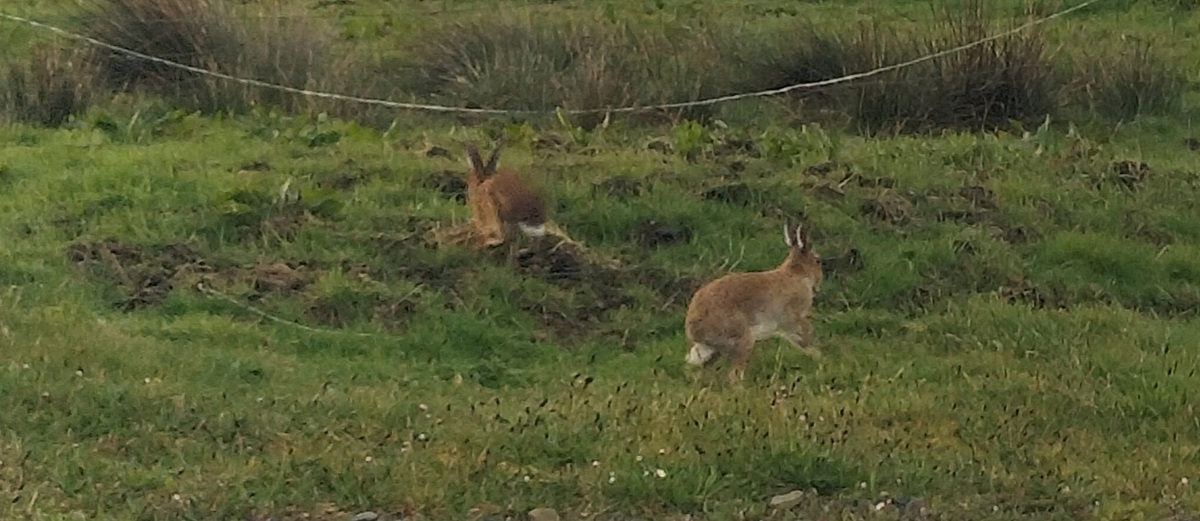
Today was joyful. I observed two adult hares grazing in the grass, closer to me than they had ever been before. The female is heavily pregnant.
After some time a breeze picked up and the couple sensed me watching. Seeing them sprinting up the hill, white fluffy tails luminous against the grass, fills me with awe every time, but it’s tinged with sadness. Are they full of fear every time they make moves? I hope not.
This is their land, of course. All of it: the whole island. Hares have been here since the last ice age.
The hare can reach up to 70km per hour. Long may it thrive.
Later, one of the leverets who was born in January arrived for a nibble in the sunshine. I walked around a corner to see the little one on the sun dappled grass. We both got a surprise!

I expected junior to take off, but she stayed exactly where she was. She sat upright, body perfectly still for a few hearbeats, then returned to eating.
Not for the first time, this made me curious about the hare’s eyesight. Does it depend on scent and hearing most of all? I’ll have to find out. Adults can detect movement from within a few metres for sure, and they are super-sensitive to sound.

Mountain hares avoid fields where cattle and sheep are present, and I’m glad to be seeing them more often these days. Slowly, slowly the season is changing. The ground is warming up, and plenty of new green shoots are appearing.
The Irish hare is the only native Lagomorph. It has been here for over 12,900 years, according to Vincent Wildlife. It eats a variety of grasses and in upland areas heather, thyme and woody plants are also eaten. Females can have 1-4 litters per year.