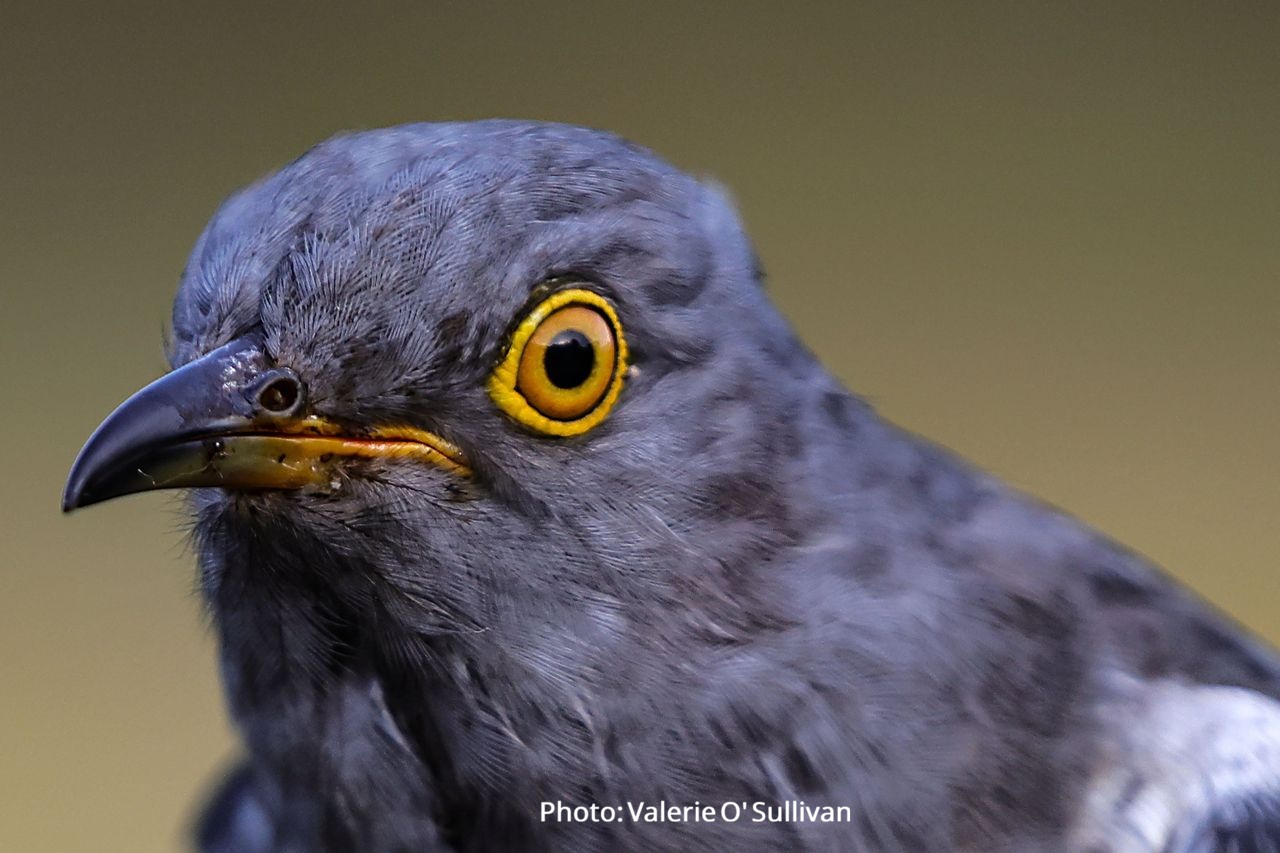
Before I moved to the rural area where I live now, I’d never heard a cuckoo. The first time I heard one was in 2023. Pictured above is Cuach Torc, a cuckoo who was tagged on in May 2023 at Killarney National Park in Ireland. He is named after a Kerry mountain. The cuckoo’s movements are being tracked by the British Trust for Ornithology (BTO), in association with the National Parks and Wildlife Service of Ireland.
One aim of the study is to discover if Irish birds differ in comparison to cuckoos who migrate to Africa from Britain. Cuach Torc has flown to France, Spain, Africa, and back to Ireland. He has traversed the Italian alps, and been to Egypt and Sudan. In October 2025, he crossed the Sahara and was last heard of in Chad. Then….silence.

Six months later, on March 19th, 2006, researchers received a signal from the the shores of a lake in Ghana. Cuach Torc was alive and well!
The team assume that while Cuach Torc was ‘offline’, he spent a few months in the rainforests of the Congo. This would be his usual pattern.

Status: dead?
The BTO website has lots of information about about migratory flight patterns, and so much more. But one detail is disconcerting. A profile photo of the cuckoo appears ‘presumed dead’ underneath it.
If you have the type of brain that takes things literally, when you visit the page, don’t be put off. Ignore the ‘dead’ declaration, and scroll down for an interactive map and other details.
A lack of signals from a tracking device for a few months is not proof of death. Technology glitches have occured before. Ornithologists say that information often comes through again when the birds move to different areas.

Crossed wires
This Spring, I decided that from now on, I will not report innacurate information and malfunctioning websites. I did so for five years. Yes! Every time I came across a confusing or unhelpful site, a broken link, or a public services site that made it impossible to carry out a necessary transaction, I reached out to organisations to let them know. A lack of clarity online, broken links, or being sent around in circles without progress is stressful to me. Most people were grateful to be made aware of website problems, and helpful. They would test the site, find the root cause of the problem, and let me know when it had been repaired.
Every email I sent, and taking time to share links, took time and energy. But if I ignored what was wrong, no improvements would have been made.
How about you? Do you send an email or make a phonecall to organisations when you encounter malfunctioning websites?
We are being pushed towards a “digital-first” society in Ireland and Europe. This effectively mandates the use of online services for most essential tasks. And yet, many websites are broken, contain innacurate details, or lack crucial information for readers.

Web Accessibility Directive
Web Accessibility Directive, or WAD, was adopted on 26 October, 2016. It requires all EU public sector bodies to make their websites and mobile apps accessible to everyone, including people with disabilities.
The standard is linked to the EU’s official harmonisation process. This means that it must be developed by European standards bodies and referenced in the EU Official Journal to have legal effect. The overall goal is to make public digital services more inclusive, with clearer rules, accessibility statements, feedback options, and monitoring/reporting by Member States.

Ireland online
The Disability Act 2005 places ‘…obligations on public bodies to make their public buildings, services and information accessible to people with disabilities‘.
Despite this law, researchers from Dublin City University (DCU) and the University of Central Florida reported on the lack of care shown by councils all over Ireland in a paper at the Seventeenth International Conference on Digital Society (2023).
Councils are not fixing key issues on their so-called ‘local authority ‘websites. On the plus side, research about digital society is slowly gathering momentum. Hopefully, this will lead to improvements for society over time.

Neurodiversity research
If you’d like to participate in studies, here are two researchers wno are seeking input.
1. Laura Eaton at Utrecht University is investigating Daily Social Experiences at Work and Wellbeing in Adults with Autism.
The study is conducted entirely online and is available in both English and Dutch at https://survey.uu.nl/jfe/form/SV_bmb5XyGuKPY5vGS Daily Social.
To contact Laura, email l.m.eaton@students.uu.nl
2. At the University of Portsmouth, Rebecca Scully wants to interview non-autistic people about growing up with an autistic sibling.
Email rebecca.scully@myport.ac.uk for details.
_________________________
The photo of the cuckoo at the top of this post is by Valerie O’Sullivan.
Writing, art, and photos © Kathryn Mary Crowley 2026. If you share this blog post, please let me know by email. You can also get in touch by email to request research services, writing, or talks.